Tuesday, June 28, 2011

Life's a beach in Switzerland

Yes, Switzerland has beaches. Seems quite remarkable for a landlocked country where the nearest coastline is 250 kms away. But today I needed a beach to swim at. It's been pretty hot here the last few days, with today the hottest day of the year so far, reaching 35C (that's 95F for my Imperial system friends). As an Australian who's used to the odd 40C (104F) day during summer, 35C is hardly something for me to blink at - except this is Switzerland. Seems strange to be wanting to go to the beach given only a few months ago I was writing about snow - or Geneva's distinct lack of it. But ever since I moved here, I was fascinated by what it would be like to swim at a beach that is actually a lake; we just don't have anything like it where I'm from in Australia.

So today, given the hot weather, I decided to try swimming in Lac Leman. I wasn't quite sure what to expect, other than the water to be really cold. I remember dipping my hand in the water during winter and thinking it was so freezing cold that the water would never tempt me in. The water in Lac Leman, after all, is virtually melted snow from the Alps. Thankfully, the water has warmed up somewhat since then. While the water temperature induced a few 'oh my gosh, it's cold' gasps on first entering, it actually turned out to be fine and rather refreshing once I'd got out.

Not much to be said for the wide expanses
of white sand at Nyon Plage
But the 'beach' itself is something else. To me, a beach is made up of kilometres of wide, blindingly white sugar-fine sand, with deep blue water and crashing waves. It's what I've grown up with; I still remember my dad piling my mum, brothers, the dog and I into the car for the 15 minute trip to the beach as a kid. But the beach in Nyon is completely different. True, it has an amazing backdrop of the Alps - which actually seems rather surreal. It also has the most clear, blue, calm water that does look quite inviting on a day like today. But its beach is maybe 2 metres wide if it's lucky, a mix of river sand and pebbles.

But the backdrop more than makes up for it
- the Alps
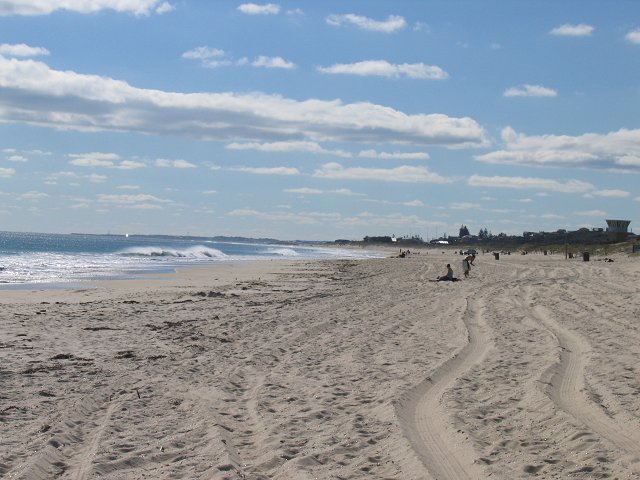
It's quite strange that it's only taken us the first truly hot day to go to the beach here; back home, we actually very rarely went to the beach, even on the hottest days. My local beach, Scarborough, is pretty amazing for a suburban beach - it's pretty much as I described what my definition of a beach is above. But we never go, even though it's a 5 minute drive away. Mostly because my mother-in-law has a swimming pool, which is convenient. But also because we're not really beach people. Beaches at home tend to get very windy once our famous sea-breezes are in, plus the waves can be quite dangerous. Plus, having grown up aware of the need to be careful of the sun, it gets pretty intense out there, and you can get sunburnt very easily.
My local beach back home, Scarborough Beach

Despite the lack of waves or nice white sand, I think I could become a beach person pretty easily in Switzerland. Grass is much easier to get out of your swimming suit bottoms than sand, and there's something to be said for swimming in calm waters. Now all we need are more 35C days to tempt me in!

Wednesday, June 8, 2011

Chaos and confusion on travel

So I’m writing this while sitting on a plane somewhere over the Atlantic at 36,000 ft. I’m on my way to New York for work and on the way back I’ll be stopping in Madrid for a few days to take in the sights and to see my colleagues in Madrid. But today has been an observation in the barely organised chaos that is international travel. To get to New York, I’m going via Madrid, which is fine – I’ve taken worse flights than to have to make a slight deviation in direction for a stopover first. However, this morning’s flight from Geneva was delayed by an hour – not very Swissifficient that - and this afternoon’s flight from Madrid was also delayed by at least 40 minutes. It turns out though that by the time I touch down at JFK the flight should more or less be on time.

Airports themselves can be a really curious mix – unsure of whether they want to display the wares of the country people are leaving from, or what they think people want. Geneva airport, which is not a big airport by any means, has a mix of shops of both Swiss brands and international luxury brands. While you’re waiting for your flight to anywhere that is not Geneva, you can browse through Swatch, Montblanc, any number of Swiss watchmakers such as Raymond Weil, Frederic Constant or Omega, and buy as much Toblerone as you please. If your credit card limit stretches that far, you can also buy up a storm at Hermes, Cartier, Ralf Lauren and Chopard. (Seriously, Chopard? Who has the cash and the time to lay down $10,000 or more on a Chopard piece at an airport?!) The Swiss brands at Geneva airport make sense, as do the luxury ones given that Geneva is a city with some seriously wealthy people.

So after arriving in Madrid and browsing the airport shops while going from one delayed flight to the next, I was stunned. I thought I had maybe landed in some alternative Switzerland or a remodelled Geneva airport. The shops in this Spanish city’s airport were, in fact, all Swiss. The Montblanc, the Swatch of Geneva airport was to be found everywhere at Madrid airport; there was a predominance of Swiss brands and nothing Spanish. Startling. I had expected to find at least one shop selling espadrilles. But nothing.

But if airports are sometimes an object of curiosity, the act of boarding a plane can make people especially so. In Geneva, apart from the uncustomary delay of the plane leaving, the departure process was a model of Swissifficency. A polite boarding call, an orderly queue to board, people quietly finding their seats and sitting in them; no problems. But never have I ever seen anything so farcical as the boarding process at Madrid airport.

First, according to the flight departure boards, the flight was on time, then it wasn’t, then it was, then it changed gate, then it didn’t. Second, they don’t make announcements to make you aware of those changes. In the end, while boarding commenced on time, it certainly didn’t end so. There was one solitary lady that was processing the boarding passes for the entire full plane load of mostly Spaniards and Americans. Being a Transatlantic flight, the plane is not a small one either.

I don’t know what it is, but as soon as the purser looks even close to announcing the boarding call, people congregate outside the gate as if they must be first on the plane – even though they will simply sit on the plane for the next 30 minutes while everyone else boards too – or as if it will leave without them. So this seemingly innate instinct in some people naturally caused a small crowd to develop around the gate. Then, when the actual boarding call came, it became a mob. And with one lady checking the boarding passes of over 350 people, boarding quickly became a mess. Americans complained loudly, both to each other and to the poor Iberia check-in lady. Spaniards also complained, in quiet, albeit mildly irritated, accents. The immigration policies of the US before leaving the country of departure also don’t help, with anyone not American or from the EU pulled out and asked to provide more details.
The 'queue' at boarding at Madrid airport

Once I actually managed to get through boarding at the gate, I was met with the ludicrous sight of not boarding a plane, but a bus. Turns out that they suddenly had to switch planes and the new one was in a different location. On the plane, it didn’t get any better, with passengers haggling over seats. The seat allocation on the boarding pass is actually supposed to prevent this, but it still didn’t stop a group of people debating in the aisle next to me over whether they could swap seats with other people just so they could sit next to their friends, while already pissed off people from the delayed flight and farcical boarding process got even more pissed off at being further held up. Honestly.

I enjoy travelling, and even when it goes wrong it pays to have a sense of humour. As a people watcher, I find it also pays to have an appreciation of the idiosyncrasies of others – in fact vital, as it can make things quite entertaining when you’d otherwise just be joining them in being frustrated, pissed off and annoyed. And that’s not meant to be part of the travel experience.

Update - 10 June

So about a week after I experienced those delayed flights and a few days after I posted the above, the situations has gone from farcical to hysterical. I was supposed to leave New York for Madrid last night at 9pm, but with severe thunderstorms, many flights were delayed, and incoming flights were diverted to other cities, including the one that we were meant to fly on. So with our plane diverted to Pittsburgh, our flight from JFK was inevitably cancelled. But that was just the start. There was confusion on where to collect the bags from. We were told that the buses to take us to the hotels would be leaving at 10.30pm. Five buses were needed to take all the passengers - I was next in line to get on the third bus when I was told it was full, and actually ended up being the very last person to board the last bus, at 11.45pm.

The scene at JFK while waiting for a bus to
take about 200 passengers to hotels
It was nearly 1am by the time we got to the hotel; because ours wasn't the only cancelled flight, all the surrounding hotels were full, so we had to schlep out to Long Island, over an hour away. I managed to get a room at the hotel relatively quickly having used strategic tactics to get towards the front of the line. Finally I get to sleep at 2am.

The next morning, we're told that the buses will pick us up to take us back to JFK at 12 noon, but being Iberia, they don't show up and leave until nearly 2pm. Which means that the 3.30pm time the flight was going to leave is now not possible and after boarding the plane at 5.30pm, we finally take off at 6.30pm.

I'm sure you can't blame me, if, after all that, I say that I refuse to fly with Iberia ever again - except to get home to Geneva of course. Stay tuned for the inevitable disasters on that leg...

Sunday, May 15, 2011

No douze points for Suisse/Schweiz/Svizzera

The Eurovision Song Contest was on last night, and this year Switzerland was in the final. While Eurovision is always kitsch and cheesy, some of the songs are quite good; really catchy. I actually liked Switzerland’s entry this year – ‘In Love for a While’, by Anna Rossinelli. But it seems nobody else in Europe did.

Switzerland came stone last with just 19 points, miles behind second-last placed Estonia with 44 points. It was also one of only three countries not to be given ‘douze points’ (twelve points, the maximum a country can give an entrant), and I think most of their 19 points came in one ‘dix points’ (10 points) haul from one country (I forget from whom, and the detailed voting results aren’t up yet).

Eurovision is always famous for its country-block voting, where the Scandavian countries all vote for each other, as do the former Soviet bloc countries. But it seems Switzerland has no friends who will vote for it. You would think three of the countries that surround it and give it three of its four official languages – France, Italy and Germany – would vote. They might have given them some votes – I don’t really remember – but I don’t think any of them they gave Switzerland the big three; ‘huit points’ (eight points), dix points or douze points.

And I wonder why. A couple of my friends on Facebook I think have summed it up; in response to my post on Switzerland coming last, my friend Julia said ‘that’s what happens when you’re neutral’ and my friend Teri said ‘no friends, no enemies, no nepotism gets you 19 points’. That has to be it; the fact Switzerland is neutral and doesn’t create waves for itself with its neighbours.

I always thought Switzerland was one of those countries in Europe that people liked, or at least respected. Maybe they do; I’m not European, so I can’t really tell, and I haven’t been here long enough to really know. But maybe the rest of Europe just doesn’t think about Switzerland. As Teri said, Switzerland has no friends and, having not been in a foreign war since 1815 (I’m not counting Afghanistan – who hasn’t been in that one?), no enemies. They’re also not part of the European Union and don’t have the euro or crippling national debt. Apart from internationally controversial and little understood laws and policies, like assisted suicide, I think Switzerland rarely makes the news.

I read a great book recently, Swiss Watching, by Diccon Bewes, an English expat now living in Bern. His book was a revelation for someone new to Switzerland, the Swiss and Swiss ways. I think it should be required reading for expats. Several times while reading the book I had a eureka moment, where he would write on something I was curious about but didn’t know the answer to. Like what’s with the little yellow signs everywhere? (They’re hiking signs, to help the Swiss find their way in their obsessive love of hiking.) And with the people canvassing in the town centre every Saturday? (They’re trying to get people to sign a petition so that a referendum can be called, the main way of laws being passed in Switzerland.)

Mr Bewes outlines in his book the parts of Switzerland’s history, over 700 years of Swiss-ness, of why the Swiss are what they are today. The cover of Swiss Watching might have the answer as to why Switzerland came last in Eurovision this year – “Switzerland may be more than 500 miles from the nearest drop of seawater, but it is an island at the centre of Europe. Welcome to the landlocked island.” Indeed.

Thursday, April 28, 2011

Mobility mobiles and Boris bikes

Don’t have a car or a bike in Switzerland? No problem, you can still get around. Although I’ve outlined the problems I’ve had with Swiss trains, they really are quite efficient and can get you to all corners of Switzerland in no time. But sometimes it’s easier to go by car or bike.
Mobility mobiles docked at a station

So when we moved, we did our research and stumbled on the concept of car sharing. Mobility CarSharing is all over Switzerland; the website says they have over 2,500 cars available at over 1,250 stations throughout the country. You can even hire cars in Austria and Germany. We’ve found carsharing to be easy to use, plus it’s environmentally friendly and cost effective; we undoubtedly save thousands of CHFs in petrol, insurance, parking and registration. I’ve registered as a member, which costs around CHF200 with a SBB Half Fare card (more on that in an upcoming post). Then you just pay for your use by the kilometre and the hour. So for 2.5 hours and 14kms it took to move from our place in Sticksville to our new place in Nyon cost less than CHF20. Beats hiring a car through a rental company or getting a taxi!

Driving them is another matter. Like a rental company, you can hire different categories of vehicles from Micro (a cute little two-seater Smart car) up to Transport (a Mercedes Vito van), great for IKEA trips. And that’s the thing. Each car is different and not like the car you’re used to driving. Back home, I have a manual drivers’ licence but drive an automatic. So while I can drive a manual, it had been awhile since I’d done so, and getting used to different cars can sometimes produce interesting results. The first car I hired was a Renault Megane. I discovered – at the traffic lights in central Nyon with four other cars behind me – that it has a high clutch point and is really easy to stall, repeatedly. I’ve also hired a Mazda that I must have come very close to burning out the clutch on.

Then there’s driving in Switzerland. First, being from Australia means I drive on the left side of the road, and the right-hand side of the car. Having to do the opposite of both has produced some tense moments, especially when approaching slip lanes and left-hand turns across oncoming traffic. Emperor D and I have on a few occasions exchanged panicky words when we think an accident is imminent. Thankfully we haven’t had any dramas yet.

Secondly, there’s the speed limit. I often don’t know what it is, as it’s frequently not signposted. This is strange for me, where speed-limit-obsessed Australian traffic laws mean virtually every street, road and highway is sign-posted every 500 metres. Driving on Switzerland’s highways for the first time a few weeks ago, I pulled onto the highway and sped up to 100km/hr, the speed limit on Australian suburban freeways. Cars whizzed past me at least 40-50km/hr faster. I sped up to nearly 130km/hr, but cars were still passing me with ease – they were doing at least 150km/hr or more. And I’m surprised. This is Switzerland, not a German autobahn! I would have thought that the conservative, rules-obsessed Swiss would have had a strict speed limit, of maybe no more than 120km/hr. And apparently, that’s actually correct; according to Wikipedia, Switzerland’s speed limit is 120km/hr. That’s a lot of Swiss breaking the rules.
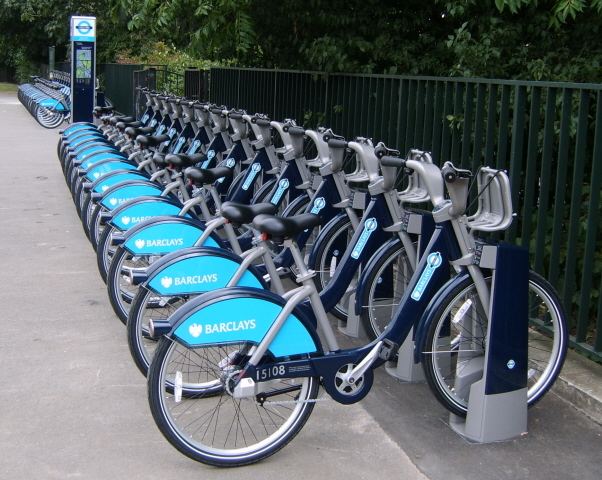
Boris bikes at docking station in Hyde Park
Image: ZanMan, WikiMedia Commons

If you can’t drive, there’s always bikes. It seems that most people in Switzerland own one, and a few of my colleagues get to work on a bike. But maybe Geneva needs to take a leaf out of London’s book. I recently spent a week in London. A lot of people there rides bikes to work too, but some with a difference; they have public bikes for hire, nicknamed Boris bikes. It seemed that one out of three bikes on the road was a Boris bike. Boris bikes, by the way, were nicknamed after London’s Lord Mayor, Boris Johnson, a bit of a London personality, and are a public bicycle sharing system where the bikes get docked at stations all over the city. I hired one on a sunny Sunday morning and took it through Hyde Park. It was one of the best things I did in London; they’re loads of fun.
Velopass bike sharing station in Morges

It’s something they should do in Geneva, and I can’t see an excuse for them not to do it. There are good bicycle paths in the city and there is even an example close to home, with a few towns in the neighbouring canton of Vaud having a bike sharing system, though on a much smaller scale. The city of Lausanne, and surrounding towns of Morges and Rolle, have the scheme. If they’re cheap to use and run, environmentally friendly, and get people out of cars and off public transport – as well as getting them doing something healthy – then why can’t Switzerland’s second biggest city, Geneva, do it too? Genevoise unite and get on yer bikes!

Update: turns out there is a bike hire system in Geneva, but it's not quite on the same scale as London, and it's suggested that the one in Morges and Lausanne is a trial to see how it runs. I hope it gets to Geneva in it's full capacity soon - Geneva is made for cycling!

Monday, April 11, 2011

Lessons in moving

So admittedly I’ve been a bit radio silent lately. You could hardly blame me after the constant moving about of the last four weeks though. What a debacle. We’ve certainly learnt lessons along the way – and so you can profit from them, I’ve listed them in gory detail below – but the important thing is that we’ve finally moved into our permanent apartment, and don’t intend on moving anywhere for a rather long time!

Lesson #1: If you think you think you need to extend your sublease, then do so!
So our problems started when we realised that our new apartment (which is just that – brand new, therefore under construction) wasn’t going to be ready as soon as we’d hoped. We’d signed a lease in early February and were told we could probably move in mid/late March, although our lease, to be on the safe side, was dated from 1 April. Our sublease in Sticksville ran out on 21 March and we thought we’d probably be safe. Wrong. When we realised that we needed a place to stay for an extra week, thinking we could move in on 27 March, it was too late to extend our sublease.

So we had to move out and we spent the next week shifting between friends’ place in Nyon and a temporary sublease for a few days in Geneva. Then on the Thursday before we were due to move in, I got the bad news that it was pushed back by an extra week to 1 April, April Fool’s Day. I wish it had been a joke. It wasn’t.

Not able to stay where we were, we had no choice but to find a hotel for the week, an expensive prospect to say the least. After an ultimately fruitless search in which neither the web, asking in hotels directly, or just asking at the tourist office – where we discovered there was not a hotel room in Geneva to be had for love nor (anything less than an exorbitant amount of) money – we gave up and headed for Lausanne for three nights, before finding a bed in Geneva for the last two before finally moving in. Glad to be in our own place at last, but the fun had only just begun.

Lesson #2: Don’t buy IKEA furniture in bulk
Of course, a brand new apartment is usually unfurnished, so we needed furniture. Ergo, like any good expat in Switzerland who needs furniture, we took ourselves off on a trip to IKEA.

To kit out our apartment, we needed to buy up big. BIG mistake. I love IKEA and - most of the time - their furniture. I have this mild obsession with anything Scandinavian, so usually that's enough to ensure my favour - the price, functionality and design is a bonus.

But good things need to come in small doses. I've spent the better part of the last 10 days on the floor putting things together - dining table, chairs, tv cabinet, lamp, bedside table, bed, bathroom cabinet, and joy of joys, a Manstad fold out sofa. We usually don't have problems putting together IKEA stuff, but this sofa is proving to be a nightmare.

You can have the chaise lounge left or right; they provide the instructions for first right, then left. We've chosen to put ours on the left, so it's meant that a couple of times we've put bolts on the wrong side and had to take them out again because we've looked at the right-side instructions first, which are wrong.

Then there's the end part which we're supposed to fasten to the seat, but the part in the hole that the screw goes into fell into the end part, rendering it useless. We took another trip to IKEA to get a replacement part, but that hasn't worked either, so we now have a half-finished sofa lying in pieces all over the living room. After two phone calls and two more visits to IKEA, it’s still not fixed. I’m not impressed at the lack of Swissifficiency (a hack word of Swiss + efficiency that I’m claiming I coined). I love IKEA but I've learnt a good lesson - don't buy it and put it together in bulk!

Lesson #3: Be prepared to fit your apartment out with just about everything – except the kitchen sink
So the above may be a slight exaggeration, but I was nonetheless startled to find that we need to fit our own light fittings in our new place, plus things like curtains. I thought the bare light bulbs (or no light bulbs, in the case of the kitchen) were going to be replaced, but it turns out that if you rent an apartment, you often have to bring or buy your own light fittings and curtains, etc. Each to their own, but I was a little surprised; that’s just not The Done Thing at home in Australia.
View from my new apartment - Alps
in the distance!

Lesson #4: Be prepared to sit back and allow your amazing surroundings to sink in
After all the hassles and stress, it’s important to stop for a moment and let things sink in. A couple of days after moving in, I stopped for lunch out on the balcony. It was gloriously sunny and (for early April) ridiculously warm. I was finally in my new apartment – it dawned on me that I won’t have to move again for a very long time. It’s brand new, so it’s a blank canvas, complete with shiny new kitchen toys, including a dishwasher (hello Empress Eats blog!). And then I looked up – and saw the French Alps, rising above Lake Geneva. No matter how long we live here, I don’t think that’s something I’ll ever get tired of.

Saturday, March 12, 2011

Up in smoke

Growing up in Australia we were exposed to public health campaigns that were nothing if not prolific. The two that stand out though are Slip, Slop, Slap and Quit. Slip, Slop, Slap was a huge campaign starting in 1981 that encouraged people to ‘slip on a shirt, slop on some sunscreen, and slap on hat’ to guard against skin cancer, which is a big killer of Australians. As a child during the 80s, I remember the television ad vividly, with its cartoon seagull and catchy jingle.

The other, the Quit campaign, still runs today to encourage people to quit smoking. It has been enormously successful, with smoking virtually banned in all public - and some private - places in some parts of Australia. You cannot smoke in restaurants, bars and nightclubs, at some areas of the beach or parks, and even your own car if there are children inside. The Quit campaign and ensuing laws has made smoking almost socially unacceptable, and there are very few people I know in Australia who are smokers.
Follow the cigarette butt road

I personally hate smoking. It smells, it’s expensive, it prematurely ages you, it’s pretty damaging to your health and of course, it can kill you. So with that attitude to smoking I came to Geneva. Where every second person, it seems, is a smoker. Again, I don't know if it's a Swiss thing, or if it's the French influence coming through in this French-speaking part of Switzerland, but a lot of people here smoke.

Walking the streets of Geneva I feel like I'm constantly dodging clouds of cigarette smoke being blown around me. Clearly there is no quit smoking campaign in Switzerland - or if there is, it's ineffective in Geneva.

Interestingly, the cigarette packs do have those graphic warning labels on them. But judging by the number of cigarette butts on the streets and the cliques of people smoking outside their workplaces, they’re not working.

Obviously smoking here is a social and a cultural thing. I've walked past women well into their 70s sucking on a cigarette. But given the cost - to your wallet, to your looks, to your health - this is one aspect of Genevoise culture I think they can do without. I've seen firsthand – from a sick family member – that it's just not worth it.

Sunday, March 6, 2011

Home sweet home is… the first place you’re offered

Anyone reading this who is Swiss or an expat living in Switzerland might be mildly surprised I haven’t blogged on this topic before – housing. I read an article recently that said housing was the number one area of concern for expats, beating security and transport. Then I read another article that said Geneva was ranked the tenth most expensive city in the world for expats to rent. I’m only surprised it wasn’t higher up the list. A decent one bedroom apartment in Geneva costs CHF2000 a month. At least. That’s CHF500 a week. And that’s just an okay apartment in an okay neighbourhood. Then a lot of owners want three months’ rent upfront as a security deposit. If your apartment is CHF2000 a month, then that’s CHF6000 you have to find. No wonder people worry about it.

I found very early on, in my research before leaving Australia, that housing in Switzerland – and in Geneva, especially – is both difficult to find and very expensive. This was only reinforced on day one at work. On my first day, I met a lot of people whose names I couldn’t (and some of them, still can’t) remember, plus a lot of other details that very quickly went out the window. But one thing stuck – the typical conversation I had with most people on meeting them. It went something like this:

Them: Nice to meet you. It’s great to have you on board.
Me: Oh, thanks, nice to meet you too. I’m really glad to be here.
Them: Where are you from?
Me: I’m from Australia; Perth to be exact.
Them: Australia? That’s great, I love Australia.
Me: Thanks. I think Switzerland will be great.
Them: So… have you found a place to live yet?
Me: Er, no – I arrived only four days ago.
Them: Oh, okay. Well, good luck with finding a place. Housing here is pretty expensive and hard to find.
Me: Oh, er, thanks for the tip (and after having this conversation five times)… I’m beginning to get that idea.

And they weren’t kidding. I’ve read that other expats, if they ‘go it alone’, can take up to three months to find a place. Emperor D and I decided before we left that we would take the easy (read, more expensive) route and hire a relocation agent. They are people who deal with mostly expats to help them find cars, schools for kids, etc, but especially a place to live.

When we arrived we stayed in a hotel for two weeks, then moved to a sublease for two months (where we’re still currently staying) just outside a village I’ve nicknamed Sticksville. Two weeks after arriving, we found a town just outside of Geneva, called Nyon, that we wanted to live in, and hired a local relocation agent. He did the job. After two weeks of meeting him and giving him our requirements, we signed a lease on a brand new apartment, seven minutes’ walk from the train station. It won’t be ready until later this month – and we can’t wait – but we’ve had a few sidesteps along the way.

We also found a sublease in Geneva that was literally next door to where I work. I could’ve rolled out of bed and had the world’s shortest commute. Things were very positive and we were looking good for getting that place, until we heard we’d missed out because the current tenant found that one of the people who applied had a workmate/friend in common. It’s not unusual for an apartment viewing to have 20 people show up.

But it seems ‘who you know’ is a common theme. A South African couple we’ve become friends with after they moved to Geneva and she started work the week after me, found their rent-so-cheap-it-must-be-too-good-to-be-true apartment through a friend of a friend after less than two weeks. Needless to say, I was a bit envious. I have a close friend here – actually more like family; my host sister – who lives less than two hours’ drive away and even works in real estate for expats. She couldn’t help us much because she doesn’t know the area and doesn’t know anyone here.

Then we found a place in Nyon that is bigger, cheaper and only two minutes’ walk from the train station, and on the ‘right side of the tracks’, that we thought was great. We saw it, applied for it, but it’s since become a little complicated. Although compared to other expats we’ve had it rather easy, we’ve now got to that point where we’re saying ‘home sweet home is the first place that’s accepted us’. And that’s fine. It’s a brand new apartment and, in a few weeks, we’ll be living there. We can’t wait. But watch out for blogs on the joys of moving and IKEA furniture buying!